
Disclaimer: Aside from parts of Black Panther, I've not read many comic books; and I've only read one graphic novel (Satrapi's Persepolis), one graphic memoir (Bechdel's Fun Home), and one graphic biography (Krimstein's The Three Escapes of Hannah Arendt). Still, even as someone not well-versed the genre, I was easily absorbed by the latest book of poetry by Derricotte Chair and Professor Gary Jackson, which the publisher refers to as "a graphic novel in verse form." 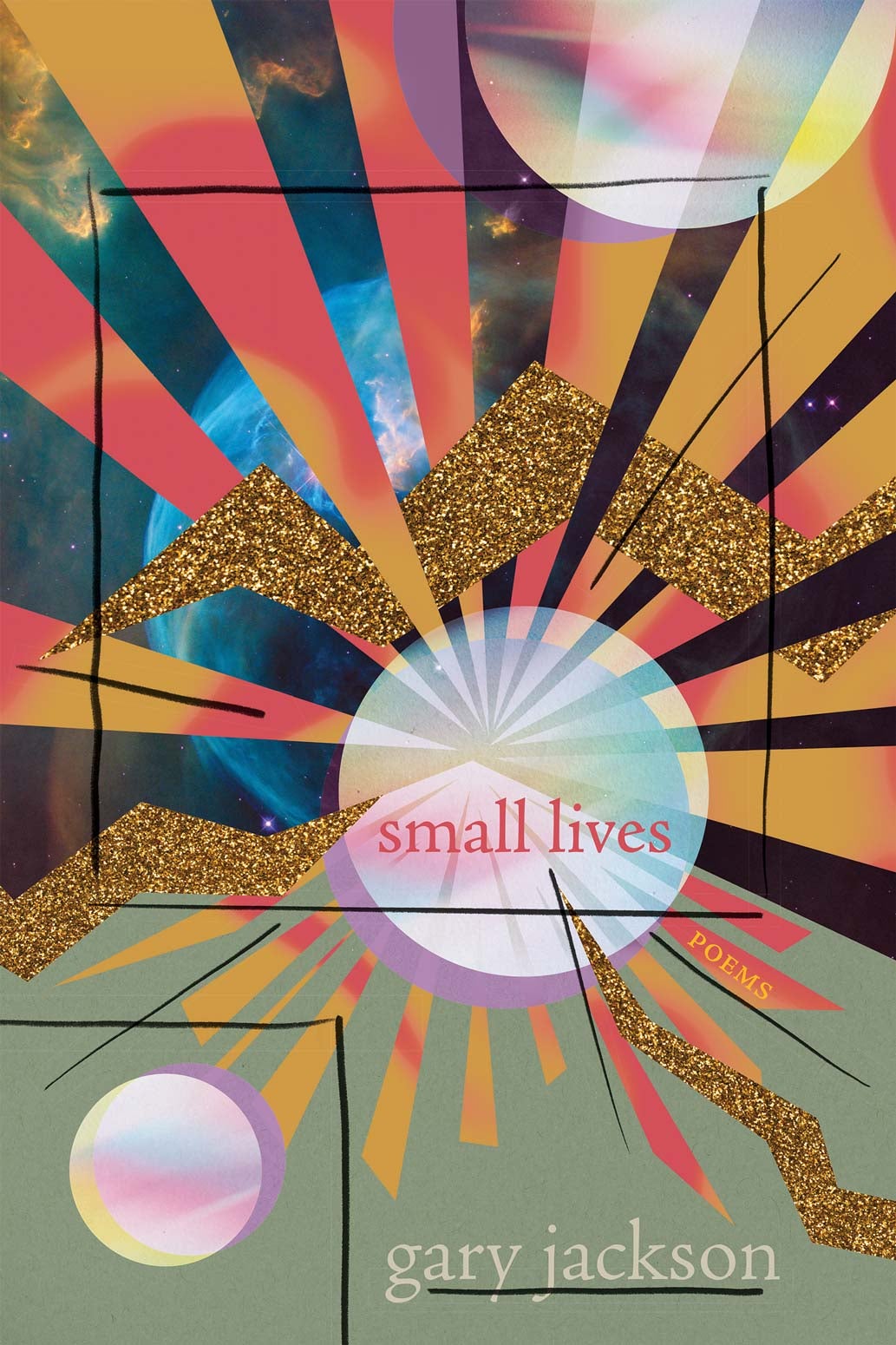
As do most comic books, small lives (University of New Mexico Press, 2025) challenges the reader to keep the cast of characters straight, using pronouns as emblems in lieu of explicit illustrations. At the beginning of the book, which mixes verse and prose poetry over four parts and an epilogue, a dramatis personae introduces readers to the main characters: The Invincible Woman (pronoun: "you"), The Telepath ("she"), and The Willpower Man ("I"). While each of these characters has one or more superpowers, it becomes clear as the book proceeds that they are part of a team in service to a nation: "We were told we were the inaugural class, that we would be the change our country needed" ("our leader," 27). Each of the three main characters embodies different modes of being Black in the United States—modes of survival, modes of excellence, modes of triumph.
The Invincible Woman ("you") works tirelessly to "save the ones never meant to survive" ("tryouts," 46). The word "invincible" being just a few letters away from being "invisible," she questions the value of recognition by the larger society for her superhuman labors. The prose poem "on acceptance" highlights one such moment of ambivalence:
The bipartisan crowd applauds when the Governor pins a medal on you. He's not delicate with the sharp point because he assumes you can't feel it pierce your chest. He's wrong on both counts: the pin can't pierce you at all, just folds under its own failure to hurt you. But you can feel the warm metal, it just doesn't bother you. You've been practicing since you were a child: learning how to turn it off and on like blinking. (49)
While the Afrofuturism label applies to small lives, the only way to imaginatively launch into the future is from the present. Through the lens of the present, this passage evokes contemporary discourse around medical bias that underplays the severity of Black women's pain, with documented horrific results. Moreover, the scene, in referring to a lifelong practice of turning pain "off and on like blinking," speaks to the kind of superhuman sensory and affective self-mastery that systemic racism demands of Black Americans. The Invincible Woman's ambivalence about accepting the medal is in tension with her being touted as "the first of [her] kind to receive such an honor"; thus, she finds herself in an all-too-familiar bind.
This bind comes up in both implicit and more direct ways throughout small lives. In "on power," which is in the voice of The Willpower Man ("I"), it's laid out clearly: "All my friends take their pick: promotion or fame, ignored or hung." But The Willpower Man has had enough of the bind in this prose poem: "We was busy fighting villains | getting tenure | giving talks | praying every Sunday for relief that the First and Fifteenth [amendments] can't provide. But I'm freelance now—yank the legs from under the would-be robbers and run the white-collar criminals out of every town"(50). Interestingly, this poem has a familiar epigraph—"This is not who we are"—attributed to, literally, "Everyone." The Willpower Man can levitate human bodies, raise them up into the air; he can "bend rivers with [his] hand, bring oceans to land, let it swallow you all until it's had its fill"(50). This alt-declaration of independence takes the lament so frequently spoken during the upheaval of the past ten years and challenges those voicing it to prove that this isn't who we are, while also blasting the illusion of unity implied by the national "we" with the energy of an old-time game of Asteroids. "I was raised to not raise a hand against you, to protect you from foreign actors who don't have our best interests at heart," The Willpower Man says before closing out the poem. "I'd like to know who does, and who is included in our"(50).
The Telepath ("she"), as her name suggests, deploys her often-burdensome ability to enter the consciousness of others in clutch situations the team of superheroes must tackle. By way of introduction early in the book, we learn in one scenario that "The Telepath touches the man's mind and reorders his blood and fury into lines she can read. [...] She tells herself this is good, useful work"("The Telepath," 8). Elsewhere, she is able to enter the minds of other superheroes on her team, as well as hear flowers and trees communicate in the natural world. Even more than with the others on the team, The Telepath plays a sacrificial role as the narrative reaches its crisis.
small lives is true to its billing as a narrative, the scale of the narrative as epic as its references are at once topical and allegorical. Two particular spikes in the plot span the collection. Early in the book, The Invincible Woman is "hurtling through clouds" with a boy about to explode with rage: "Look at them, the boy says. Look at what they've done to us" ("no more water," 36). In this prose poem that takes its title from James Baldwin's The Fire Next Time, the Invincible Woman tries, as they fall, to convince the youth not to combust, but "the boy flashes [her] a joyless grin before he breaks apart." Those watching and recording from the ground "gawk at what they think is a firework display." The superhero's failure to save the boy from a self-destruction that seen by the public as spectacle when not labeled as terrorism stays with her throughout the book. The Willpower Man ruminates on the event in another poem:
now I understand the man
on the bridge, the woman with a gun,
how much easier it is to destroy yourself
than change the world. ("a different world," 39)
Not unrelated to the first plot spike is a premise leading to a major crisis in the narrative. The world of small lives is a futuristic one in which there are multiple moons. In "fiat lux," the first poem of the first part of the book, the premise is speculative, asking readers to imagine such an altered skyscape: "all that wonderful moonlight filling parking lots and lonely street corners, and how we'll love it at first and wonder what, exactly, powers each moon, and how did we secure all the moons in place"(5). "At first" is important here because, in Part II, The Telepath will learn the truth: "When she looked to the sky, this is what she saw: scores of children wired to artificial moons orbiting our world: batteries to last a lifetime. What she saw made her scream, made her shout from her home, but we didn't listen. She tried broadcasting the truth directly into our minds, but we called it fake news"("The Telepath finds the bright side," 68).
What might this idea of children whose energies are used to power artificial moons signify in our contemporary world? So many possibilities offer themselves: I find myself thinking of a technological realm in which the energy of young people is drained by those exploiting them, who experience the transfer as a sort of brightness they would otherwise lack. Rescuing the children and then realigning the earth with its original moon emerge as important and seemingly impossible missions for the team in Parts III and IV. To get around spoilers, I'll only say that this mission is visualized in stunning detail and, though heroic, is not recognized as such by everyone in this society, especially those who benefit from the extraction of value from the children and those they've hoodwinked into believing they benefit as well. Fittingly, the Epilogue ends with the poem "work," signalling that, despite the superhuman efforts of the characters, despite change, despite the knowledge that what seems impossible can be achieved, there is still work to be done. The prose poem introduces the "small life" of an anonymous boy who can fly, swoop down on evildoers, and deliver them to the justice of two knife-wielding women who pay him for his efforts; the boy wears a hoodie, reminding readers of the murder of Trayvon Martin.
The magic of small lives lies is its vastness and plenitude. It is a testament to the ability of comic books to embody strong collective desires for justice and reveal deep truths about society. It's loaded with allusions to comic books (going back to the 1950s), popular culture (including music by Donny Hathaway and Diana Ross), and literature (the aforementioned reference to Baldwin, as well as an epigraph from Audre Lorde's "A Litany for Survival"). It casts itself into the future while evoking the situation, buzzwords, and phrases of the present moment, such as "fake news" and "This isn't who we are." And it keeps the past well in sight, with references to Bruce's Beach, Black Codes, and the 1985 Move bombing. "[W]e're such small lives compared to the history beneath us," the book's standalone opening poem reads, "and yet history is all we see" ("comic book plots & origin stories," 1). This experimental volume of poetry offers the pleasures of page-turning narrative in combination with the slow, multilayered density of individual poems. As such, it rewards multiple, three-dimensional readings.
—Ellen McGrath Smith
Return to Main Page